
Database Models
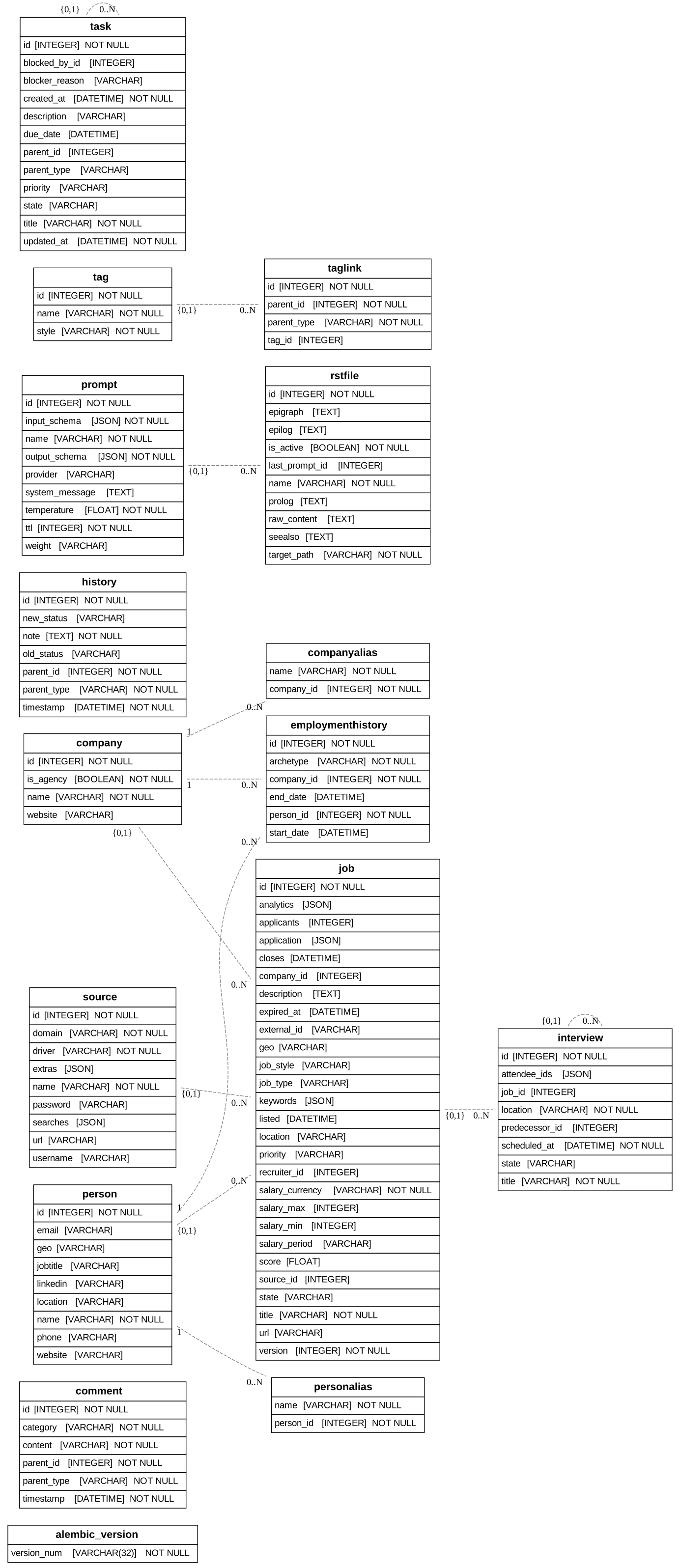
Our RDBMS layer is very interesting: obviously it incorporates all of the traditional elements - all SQLAlchemy, but in order to be resiliant, we’ve a lot of JSON fields. These all have Pydantic models associated with them, so everything is deeply Pythonic.
- class lbn.aidoc.models.Application(*, cv: Any = <factory>, letter: Any = <factory>, url: HttpUrl | None = None, **data: Any)
Bases:
BaseModelStructured JSON layout for a complete job application document set.
- class CVProfile(*, sections: List[str] = <factory>, title: str = '', keywords: List[str] = <factory>, subject: str | None = None, required: List[str] = <factory>, **extra_data: Any)
Bases:
BaseModel- keywords: List[str]
- model_config = {'arbitrary_types_allowed': True, 'extra': 'allow'}
Configuration for the model, should be a dictionary conforming to [ConfigDict][pydantic.config.ConfigDict].
- required: List[str]
- sections: List[str]
- subject: str | None
- title: str
- class LetterProfile(*, title: str = '', sections: List[str] = <factory>, freetext: str = '', marketplace: List[str] = <factory>, required: List[str] = <factory>, **extra_data: Any)
Bases:
BaseModel- freetext: str
- marketplace: List[str]
- model_config = {'arbitrary_types_allowed': True, 'extra': 'allow'}
Configuration for the model, should be a dictionary conforming to [ConfigDict][pydantic.config.ConfigDict].
- required: List[str]
- sections: List[str]
- title: str
- cv: Any
- letter: Any
- model_config = {'arbitrary_types_allowed': True, 'extra': 'allow'}
Configuration for the model, should be a dictionary conforming to [ConfigDict][pydantic.config.ConfigDict].
- url: HttpUrl | None
- class lbn.aidoc.models.Archetype(*values)
Bases:
StyledEnum- BOSS = 'boss'
- OTHER = 'other'
- PEER = 'peer'
- RECRUITER = 'recruiter'
- SCHEDULER = 'scheduler'
- SCOUT = 'scout'
- SOURCE = 'source'
- class lbn.aidoc.models.Comment(*, id: ~typing.Annotated[int | None, ~sqlmodel.main.FieldInfoMetadata(primary_key=True, nullable=PydanticUndefined, foreign_key=PydanticUndefined, ondelete=PydanticUndefined, unique=PydanticUndefined, index=PydanticUndefined, sa_type=PydanticUndefined, sa_column=PydanticUndefined, sa_column_args=PydanticUndefined, sa_column_kwargs=PydanticUndefined)] = None, parent_type: ~typing.Annotated[str, ~sqlmodel.main.FieldInfoMetadata(primary_key=PydanticUndefined, nullable=PydanticUndefined, foreign_key=PydanticUndefined, ondelete=PydanticUndefined, unique=PydanticUndefined, index=True, sa_type=PydanticUndefined, sa_column=PydanticUndefined, sa_column_args=PydanticUndefined, sa_column_kwargs=PydanticUndefined)], parent_id: ~typing.Annotated[int, ~sqlmodel.main.FieldInfoMetadata(primary_key=PydanticUndefined, nullable=PydanticUndefined, foreign_key=PydanticUndefined, ondelete=PydanticUndefined, unique=PydanticUndefined, index=True, sa_type=PydanticUndefined, sa_column=PydanticUndefined, sa_column_args=PydanticUndefined, sa_column_kwargs=PydanticUndefined)], category: ~typing.Annotated[str, ~sqlmodel.main.FieldInfoMetadata(primary_key=PydanticUndefined, nullable=PydanticUndefined, foreign_key=PydanticUndefined, ondelete=PydanticUndefined, unique=PydanticUndefined, index=PydanticUndefined, sa_type=PydanticUndefined, sa_column=PydanticUndefined, sa_column_args=PydanticUndefined, sa_column_kwargs=PydanticUndefined)] = 'note', content: str, timestamp: ~typing.Annotated[~datetime.datetime, ~sqlmodel.main.FieldInfoMetadata(primary_key=PydanticUndefined, nullable=PydanticUndefined, foreign_key=PydanticUndefined, ondelete=PydanticUndefined, unique=PydanticUndefined, index=PydanticUndefined, sa_type=PydanticUndefined, sa_column=PydanticUndefined, sa_column_args=PydanticUndefined, sa_column_kwargs=PydanticUndefined)] = <factory>)
Bases:
SQLModel- as_str()
- category: str
- content: str
- id: int | None
- model_config = {'from_attributes': True, 'read_from_attributes': True, 'read_with_orm_mode': True, 'registry': PydanticUndefined, 'table': True}
Configuration for the model, should be a dictionary conforming to [ConfigDict][pydantic.config.ConfigDict].
- property parent
Automatically extracts the database session from itself to find the parent model.
- property parent_class
- parent_id: int
- parent_type: str
- timestamp: datetime
- class lbn.aidoc.models.Company(*, id: Annotated[int | None, FieldInfoMetadata(primary_key=True, nullable=PydanticUndefined, foreign_key=PydanticUndefined, ondelete=PydanticUndefined, unique=PydanticUndefined, index=PydanticUndefined, sa_type=PydanticUndefined, sa_column=PydanticUndefined, sa_column_args=PydanticUndefined, sa_column_kwargs=PydanticUndefined)] = None, name: Annotated[str, FieldInfoMetadata(primary_key=PydanticUndefined, nullable=False, foreign_key=PydanticUndefined, ondelete=PydanticUndefined, unique=True, index=True, sa_type=PydanticUndefined, sa_column=PydanticUndefined, sa_column_args=PydanticUndefined, sa_column_kwargs=PydanticUndefined)], is_agency: Annotated[bool, FieldInfoMetadata(primary_key=PydanticUndefined, nullable=PydanticUndefined, foreign_key=PydanticUndefined, ondelete=PydanticUndefined, unique=PydanticUndefined, index=PydanticUndefined, sa_type=PydanticUndefined, sa_column=PydanticUndefined, sa_column_args=PydanticUndefined, sa_column_kwargs=PydanticUndefined)] = False, website: str | None = None)
Bases:
SQLModel- as_str()
- id: int | None
- is_agency: bool
- model_config = {'from_attributes': True, 'read_from_attributes': True, 'read_with_orm_mode': True, 'registry': PydanticUndefined, 'table': True}
Configuration for the model, should be a dictionary conforming to [ConfigDict][pydantic.config.ConfigDict].
- name: str
- stints: Mapped[List[EmploymentHistory]]
- website: str | None
- class lbn.aidoc.models.CompanyAlias(*, name: Annotated[str, FieldInfoMetadata(primary_key=True, nullable=PydanticUndefined, foreign_key=PydanticUndefined, ondelete=PydanticUndefined, unique=PydanticUndefined, index=PydanticUndefined, sa_type=PydanticUndefined, sa_column=PydanticUndefined, sa_column_args=PydanticUndefined, sa_column_kwargs=PydanticUndefined)], company_id: Annotated[int, FieldInfoMetadata(primary_key=PydanticUndefined, nullable=PydanticUndefined, foreign_key=company.id, ondelete=PydanticUndefined, unique=PydanticUndefined, index=PydanticUndefined, sa_type=PydanticUndefined, sa_column=PydanticUndefined, sa_column_args=PydanticUndefined, sa_column_kwargs=PydanticUndefined)])
Bases:
SQLModel- company_id: int
- model_config = {'from_attributes': True, 'read_from_attributes': True, 'read_with_orm_mode': True, 'registry': PydanticUndefined, 'table': True}
Configuration for the model, should be a dictionary conforming to [ConfigDict][pydantic.config.ConfigDict].
- name: str
- class lbn.aidoc.models.EmploymentHistory
Bases:
SQLModelThe Ledger: Tracks who works (or worked) where.
- company_id: int
- end_date: datetime | None
- id: int | None
- model_config = {'from_attributes': True, 'read_from_attributes': True, 'read_with_orm_mode': True, 'registry': PydanticUndefined, 'table': True}
Configuration for the model, should be a dictionary conforming to [ConfigDict][pydantic.config.ConfigDict].
- person_id: int
- start_date: datetime | None
- classmethod validate_styled_enums(v, info)
The ‘Inhale Handshake’: Forces Pydantic to use the StyledEnum constructor. This re-attaches the .style metadata lost during AI extraction.
- class lbn.aidoc.models.History
Bases:
SQLModelfor state machine transition histories
- id: int | None
- model_config = {'from_attributes': True, 'read_from_attributes': True, 'read_with_orm_mode': True, 'registry': PydanticUndefined, 'table': True}
Configuration for the model, should be a dictionary conforming to [ConfigDict][pydantic.config.ConfigDict].
- new_status: str | None
- note: str
- old_status: str | None
- parent_id: int
- parent_type: str
- timestamp: datetime
- class lbn.aidoc.models.Interview
Bases:
SQLModel- as_ical() str
Surgical Export: Generates a valid iCalendar byte string using the icalendar library.
- as_str()
- attendee_ids: List[int]
- property attendees: List[Person]
Surgical Lookahead: Direct session query to resolve the JSON list of IDs. Returns a list of Person objects matching the internal array registry.
- id: int | None
- job_id: int | None
- location: str
- model_config = {'from_attributes': True, 'read_from_attributes': True, 'read_with_orm_mode': True, 'registry': PydanticUndefined, 'table': True}
Configuration for the model, should be a dictionary conforming to [ConfigDict][pydantic.config.ConfigDict].
- predecessor_id: int | None
- predecessors() List[Interview]
Walks backwards up the chain of predecessor links. Returns a list of all prior interview objects, sorted chronologically.
- scheduled_at: datetime
- state: MeetingStatus
- title: str
- classmethod validate_styled_enums(v, info)
The ‘Inhale Handshake’: Forces Pydantic to use the StyledEnum constructor. This re-attaches the .style metadata lost during AI extraction.
- class lbn.aidoc.models.Job
Bases:
SQLModel- analytics: Any
- annual_equivalent
- applicants: int | None
- application: Any
- as_str()
- closes: datetime | None
- company_id: int | None
- description: str | None
- expired_at: datetime | None
- external_id: str | None
- geo: str | None
- id: int | None
- ingested
SQL-side expression: Generates a correlated scalar subquery. Locates the absolute oldest History timestamp for this Job.
- keywords: List[str]
- listed: datetime | None
- location: str | None
- model_config = {'from_attributes': True, 'ignored_types': (<class 'sqlalchemy.ext.hybrid.hybrid_property'>,), 'read_from_attributes': True, 'read_with_orm_mode': True, 'registry': PydanticUndefined, 'table': True}
Configuration for the model, should be a dictionary conforming to [ConfigDict][pydantic.config.ConfigDict].
- recruiter_id: int | None
- salary_currency: str
- salary_max: int | None
- salary_min: int | None
- salary_period: SalaryPeriod
- score: float | None
- source_id: int | None
- title: str
- url: str | None
- classmethod validate_styled_enums(v, info)
The ‘Inhale Handshake’: Forces Pydantic to use the StyledEnum constructor. This re-attaches the .style metadata lost during AI extraction.
- version: int
- class lbn.aidoc.models.JobStatus(*values)
Bases:
StyledEnum- APPLIED = 'applied'
- ARCHIVED = 'archived'
- DISMISSED = 'dismissed'
- HIRED = 'hired'
- INTERVIEW = 'interview'
- OFFER = 'offer'
- QUALIFIED = 'qualified'
- RAW = 'raw'
- REJECTED = 'rejected'
- SCREENING = 'screening'
- class lbn.aidoc.models.JobStyle(*values)
Bases:
StyledEnum- HYBRID = 'hybrid'
- ONSITE = 'on-site'
- REMOTE = 'remote'
- class lbn.aidoc.models.JobType(*values)
Bases:
StyledEnum- CONTRACT = 'contract'
- FIXED = 'fixed-term'
- PERM = 'permanent'
- TEMPORARY = 'temporary'
- class lbn.aidoc.models.MeetingStatus(*values)
Bases:
StyledEnum- CANCELLED = 'cancelled'
- COMPLETED = 'completed'
- PROPOSED = 'proposed'
- RESCHEDULING = 'rescheduling'
- SCHEDULED = 'scheduled'
- class lbn.aidoc.models.ModelFlattener(model: Any, relationships: List[str] = None, mappings: Dict[str, str] = None, extras: Dict[str, Any] = None, excludes: List[str] = None)
Bases:
objectThe ‘Surgical’ Proxy: Collapses FK relationships into a flat namespace. Strips internal IDs and resolves built-in collisions (like ‘id’).
- property model_fields: Dict[str, Any]
Spoofing for DisplayWidget’s attribute discovery logic.
- class lbn.aidoc.models.MutablePydantic
Bases:
MutableFramework-Native Mutation Tracker: Enables SQLAlchemy to accept rich Pydantic objects directly onto the column field without type crashes.
- changed()
Subclasses should call this method whenever change events occur.
- classmethod coerce(key, value)
Given a value, coerce it into the target type.
Can be overridden by custom subclasses to coerce incoming data into a particular type.
By default, raises
ValueError.This method is called in different scenarios depending on if the parent class is of type
Mutableor of typeMutableComposite. In the case of the former, it is called for both attribute-set operations as well as during ORM loading operations. For the latter, it is only called during attribute-set operations; the mechanics of thecomposite()construct handle coercion during load operations.- Parameters:
key – string name of the ORM-mapped attribute being set.
value – the incoming value.
- Returns:
the method should return the coerced value, or raise
ValueErrorif the coercion cannot be completed.
- class lbn.aidoc.models.Person(*, id: Annotated[int | None, FieldInfoMetadata(primary_key=True, nullable=PydanticUndefined, foreign_key=PydanticUndefined, ondelete=PydanticUndefined, unique=PydanticUndefined, index=PydanticUndefined, sa_type=PydanticUndefined, sa_column=PydanticUndefined, sa_column_args=PydanticUndefined, sa_column_kwargs=PydanticUndefined)] = None, name: Annotated[str, FieldInfoMetadata(primary_key=PydanticUndefined, nullable=PydanticUndefined, foreign_key=PydanticUndefined, ondelete=PydanticUndefined, unique=PydanticUndefined, index=True, sa_type=PydanticUndefined, sa_column=PydanticUndefined, sa_column_args=PydanticUndefined, sa_column_kwargs=PydanticUndefined)], email: Annotated[str | None, FieldInfoMetadata(primary_key=PydanticUndefined, nullable=PydanticUndefined, foreign_key=PydanticUndefined, ondelete=PydanticUndefined, unique=True, index=True, sa_type=PydanticUndefined, sa_column=PydanticUndefined, sa_column_args=PydanticUndefined, sa_column_kwargs=PydanticUndefined)] = None, phone: str | None = None, linkedin: str | None = None, website: str | None = None, location: str | None = None, geo: str | None = None, jobtitle: str | None = None)
Bases:
SQLModelThe Master Address Book: Purely digital presence. Independence: No relationships or back-links defined here.
- as_str()
- email: str | None
- first_name()
- geo: str | None
- id: int | None
- jobtitle: str | None
- last_name()
- linkedin: str | None
- location: str | None
- model_config = {'from_attributes': True, 'read_from_attributes': True, 'read_with_orm_mode': True, 'registry': PydanticUndefined, 'table': True}
Configuration for the model, should be a dictionary conforming to [ConfigDict][pydantic.config.ConfigDict].
- name: str
- phone: str | None
- stints: Mapped[List[EmploymentHistory]]
- website: str | None
- class lbn.aidoc.models.PersonAlias(*, name: Annotated[str, FieldInfoMetadata(primary_key=True, nullable=PydanticUndefined, foreign_key=PydanticUndefined, ondelete=PydanticUndefined, unique=PydanticUndefined, index=PydanticUndefined, sa_type=PydanticUndefined, sa_column=PydanticUndefined, sa_column_args=PydanticUndefined, sa_column_kwargs=PydanticUndefined)], person_id: Annotated[int, FieldInfoMetadata(primary_key=PydanticUndefined, nullable=PydanticUndefined, foreign_key=person.id, ondelete=PydanticUndefined, unique=PydanticUndefined, index=PydanticUndefined, sa_type=PydanticUndefined, sa_column=PydanticUndefined, sa_column_args=PydanticUndefined, sa_column_kwargs=PydanticUndefined)])
Bases:
SQLModel- model_config = {'from_attributes': True, 'read_from_attributes': True, 'read_with_orm_mode': True, 'registry': PydanticUndefined, 'table': True}
Configuration for the model, should be a dictionary conforming to [ConfigDict][pydantic.config.ConfigDict].
- name: str
- person_id: int
- class lbn.aidoc.models.Priority(*values)
Bases:
StyledEnum- HIGH = 'high'
- LOW = 'low'
- MEDIUM = 'medium'
- NONE = 'none'
- UNKNOWN = 'unknown'
- URGENT = 'urgent'
- class lbn.aidoc.models.Prompt
Bases:
SQLModelan LLM instruction, with well defined inputs and outputs
- compile(**kwargs) List[Dict[str, str]]
The ‘Inhale’: Uses the input_model to resolve defaults and satisfy ‘required’ constraints before the slurp.
- id: int | None
- input_model() Type[BaseModel]
The ‘Inhale Contractor’: Dynamic validation block for input parameters. Recursively compiles a genuine Pydantic model contract straight from the stored input_schema JSON dictionary.
- input_schema: Dict[str, Any]
- inputs() Dict[str, List[str]]
Decomposes the input JSONSchema.
- link(data: Any) Any
The ‘Linker’: turns dicts, etc into our pydantic output schema structure
- model_config = {'from_attributes': True, 'read_from_attributes': True, 'read_with_orm_mode': True, 'registry': PydanticUndefined, 'table': True}
Configuration for the model, should be a dictionary conforming to [ConfigDict][pydantic.config.ConfigDict].
- name: str
- output_model() Type[BaseModel]
The ‘Inhale Contractor’: High-fidelity type mapping. Recursively compiles a genuine, deeply nested Pydantic model contract straight from the stored output_schema JSON dictionary.
- output_schema: Dict[str, Any]
- outputs() Dict[str, List[str]]
Decomposes the output JSONSchema.
- provider: str | None
- system_message: str
- temperature: float
- ttl: int
- class lbn.aidoc.models.PydanticJSON(pydantic_model_resolver: Any, *args: Any, **kwargs: Any)
Bases:
TypeDecoratorThe Decoupled Database Bridge: Serializes Pydantic models to disk without requiring tight compile-time import couplings to intelligence.py.
- cache_ok = True
Indicate if statements using this
ExternalTypeare “safe to cache”.The default value
Nonewill emit a warning and then not allow caching of a statement which includes this type. Set toFalseto disable statements using this type from being cached at all without a warning. When set toTrue, the object’s class and selected elements from its state will be used as part of the cache key. For example, using aTypeDecorator:class MyType(TypeDecorator): impl = String cache_ok = True def __init__(self, choices): self.choices = tuple(choices) self.internal_only = True
The cache key for the above type would be equivalent to:
>>> MyType(["a", "b", "c"])._static_cache_key (<class '__main__.MyType'>, ('choices', ('a', 'b', 'c')))
The caching scheme will extract attributes from the type that correspond to the names of parameters in the
__init__()method. Above, the “choices” attribute becomes part of the cache key but “internal_only” does not, because there is no parameter named “internal_only”.The requirements for cacheable elements is that they are hashable and also that they indicate the same SQL rendered for expressions using this type every time for a given cache value.
To accommodate for datatypes that refer to unhashable structures such as dictionaries, sets and lists, these objects can be made “cacheable” by assigning hashable structures to the attributes whose names correspond with the names of the arguments. For example, a datatype which accepts a dictionary of lookup values may publish this as a sorted series of tuples. Given a previously un-cacheable type as:
class LookupType(UserDefinedType): """a custom type that accepts a dictionary as a parameter. this is the non-cacheable version, as "self.lookup" is not hashable. """ def __init__(self, lookup): self.lookup = lookup def get_col_spec(self, **kw): return "VARCHAR(255)" def bind_processor(self, dialect): ... # works with "self.lookup" ...
Where “lookup” is a dictionary. The type will not be able to generate a cache key:
>>> type_ = LookupType({"a": 10, "b": 20}) >>> type_._static_cache_key <stdin>:1: SAWarning: UserDefinedType LookupType({'a': 10, 'b': 20}) will not produce a cache key because the ``cache_ok`` flag is not set to True. Set this flag to True if this type object's state is safe to use in a cache key, or False to disable this warning. symbol('no_cache')
If we did set up such a cache key, it wouldn’t be usable. We would get a tuple structure that contains a dictionary inside of it, which cannot itself be used as a key in a “cache dictionary” such as SQLAlchemy’s statement cache, since Python dictionaries aren’t hashable:
>>> # set cache_ok = True >>> type_.cache_ok = True >>> # this is the cache key it would generate >>> key = type_._static_cache_key >>> key (<class '__main__.LookupType'>, ('lookup', {'a': 10, 'b': 20})) >>> # however this key is not hashable, will fail when used with >>> # SQLAlchemy statement cache >>> some_cache = {key: "some sql value"} Traceback (most recent call last): File "<stdin>", line 1, in <module> TypeError: unhashable type: 'dict'
The type may be made cacheable by assigning a sorted tuple of tuples to the “.lookup” attribute:
class LookupType(UserDefinedType): """a custom type that accepts a dictionary as a parameter. The dictionary is stored both as itself in a private variable, and published in a public variable as a sorted tuple of tuples, which is hashable and will also return the same value for any two equivalent dictionaries. Note it assumes the keys and values of the dictionary are themselves hashable. """ cache_ok = True def __init__(self, lookup): self._lookup = lookup # assume keys/values of "lookup" are hashable; otherwise # they would also need to be converted in some way here self.lookup = tuple((key, lookup[key]) for key in sorted(lookup)) def get_col_spec(self, **kw): return "VARCHAR(255)" def bind_processor(self, dialect): ... # works with "self._lookup" ...
Where above, the cache key for
LookupType({"a": 10, "b": 20})will be:>>> LookupType({"a": 10, "b": 20})._static_cache_key (<class '__main__.LookupType'>, ('lookup', (('a', 10), ('b', 20))))
Added in version 1.4.14: - added the
cache_okflag to allow some configurability of caching forTypeDecoratorclasses.Added in version 1.4.28: - added the
ExternalTypemixin which generalizes thecache_okflag to both theTypeDecoratorandUserDefinedTypeclasses.See also
sql_caching
- impl
alias of
JSON
- process_bind_param(value: Any, dialect: Any) Any
Before writing to disk: Flatten the object down to a plain JSON map.
- process_result_value(value: Any, dialect: Any) Any
After reading off disk: Re-hydrate straight back into the targeted model contract.
- property target_model: type
Lazily resolve the class type only when a database read triggers.
- class lbn.aidoc.models.RSTFile
Bases:
SQLModel- epigraph: str | None
- epilog: str | None
- id: int | None
- is_active: bool
- last_prompt_id: int | None
- model_config = {'from_attributes': True, 'read_from_attributes': True, 'read_with_orm_mode': True, 'registry': PydanticUndefined, 'table': True}
Configuration for the model, should be a dictionary conforming to [ConfigDict][pydantic.config.ConfigDict].
- name: str
- prolog: str | None
- raw_content: str | None
- seealso: str | None
- target_path: str
- class lbn.aidoc.models.SalaryPeriod(*values)
Bases:
StyledEnum- ANNUAL = 'annual'
- DAILY = 'daily'
- HOURLY = 'hourly'
- class lbn.aidoc.models.Source
Bases:
SQLModel- domain: str
- driver: str
- extras: Dict[str, Any]
- classmethod get_by_url(session: Session, url: str) Source
The Discovery Drill: Resolves Source by domain or falls back to ‘General’. PRINCIPAL: Guaranteed to return a Source object.
- id: int | None
- model_config = {'from_attributes': True, 'read_from_attributes': True, 'read_with_orm_mode': True, 'registry': PydanticUndefined, 'table': True}
Configuration for the model, should be a dictionary conforming to [ConfigDict][pydantic.config.ConfigDict].
- name: str
- password: str | None
- searches: Dict[str, Any]
- url: str | None
- username: str | None
- class lbn.aidoc.models.StyledEnum(new_class_name, /, names, *, module=None, qualname=None, type=None, start=1, boundary=None)
Bases:
str,EnumSurgical Hybrid: Identity is clean string, Style is metadata.
- class lbn.aidoc.models.StyledType(enum_class, *args, **kwargs)
Bases:
TypeDecoratorThe Bridge: Handles DB round-trips for any StyledEnum.
- cache_ok = True
Indicate if statements using this
ExternalTypeare “safe to cache”.The default value
Nonewill emit a warning and then not allow caching of a statement which includes this type. Set toFalseto disable statements using this type from being cached at all without a warning. When set toTrue, the object’s class and selected elements from its state will be used as part of the cache key. For example, using aTypeDecorator:class MyType(TypeDecorator): impl = String cache_ok = True def __init__(self, choices): self.choices = tuple(choices) self.internal_only = True
The cache key for the above type would be equivalent to:
>>> MyType(["a", "b", "c"])._static_cache_key (<class '__main__.MyType'>, ('choices', ('a', 'b', 'c')))
The caching scheme will extract attributes from the type that correspond to the names of parameters in the
__init__()method. Above, the “choices” attribute becomes part of the cache key but “internal_only” does not, because there is no parameter named “internal_only”.The requirements for cacheable elements is that they are hashable and also that they indicate the same SQL rendered for expressions using this type every time for a given cache value.
To accommodate for datatypes that refer to unhashable structures such as dictionaries, sets and lists, these objects can be made “cacheable” by assigning hashable structures to the attributes whose names correspond with the names of the arguments. For example, a datatype which accepts a dictionary of lookup values may publish this as a sorted series of tuples. Given a previously un-cacheable type as:
class LookupType(UserDefinedType): """a custom type that accepts a dictionary as a parameter. this is the non-cacheable version, as "self.lookup" is not hashable. """ def __init__(self, lookup): self.lookup = lookup def get_col_spec(self, **kw): return "VARCHAR(255)" def bind_processor(self, dialect): ... # works with "self.lookup" ...
Where “lookup” is a dictionary. The type will not be able to generate a cache key:
>>> type_ = LookupType({"a": 10, "b": 20}) >>> type_._static_cache_key <stdin>:1: SAWarning: UserDefinedType LookupType({'a': 10, 'b': 20}) will not produce a cache key because the ``cache_ok`` flag is not set to True. Set this flag to True if this type object's state is safe to use in a cache key, or False to disable this warning. symbol('no_cache')
If we did set up such a cache key, it wouldn’t be usable. We would get a tuple structure that contains a dictionary inside of it, which cannot itself be used as a key in a “cache dictionary” such as SQLAlchemy’s statement cache, since Python dictionaries aren’t hashable:
>>> # set cache_ok = True >>> type_.cache_ok = True >>> # this is the cache key it would generate >>> key = type_._static_cache_key >>> key (<class '__main__.LookupType'>, ('lookup', {'a': 10, 'b': 20})) >>> # however this key is not hashable, will fail when used with >>> # SQLAlchemy statement cache >>> some_cache = {key: "some sql value"} Traceback (most recent call last): File "<stdin>", line 1, in <module> TypeError: unhashable type: 'dict'
The type may be made cacheable by assigning a sorted tuple of tuples to the “.lookup” attribute:
class LookupType(UserDefinedType): """a custom type that accepts a dictionary as a parameter. The dictionary is stored both as itself in a private variable, and published in a public variable as a sorted tuple of tuples, which is hashable and will also return the same value for any two equivalent dictionaries. Note it assumes the keys and values of the dictionary are themselves hashable. """ cache_ok = True def __init__(self, lookup): self._lookup = lookup # assume keys/values of "lookup" are hashable; otherwise # they would also need to be converted in some way here self.lookup = tuple((key, lookup[key]) for key in sorted(lookup)) def get_col_spec(self, **kw): return "VARCHAR(255)" def bind_processor(self, dialect): ... # works with "self._lookup" ...
Where above, the cache key for
LookupType({"a": 10, "b": 20})will be:>>> LookupType({"a": 10, "b": 20})._static_cache_key (<class '__main__.LookupType'>, ('lookup', (('a', 10), ('b', 20))))
Added in version 1.4.14: - added the
cache_okflag to allow some configurability of caching forTypeDecoratorclasses.Added in version 1.4.28: - added the
ExternalTypemixin which generalizes thecache_okflag to both theTypeDecoratorandUserDefinedTypeclasses.See also
sql_caching
- impl
alias of
String
- process_bind_param(value, dialect)
Receive a bound parameter value to be converted.
Custom subclasses of
_types.TypeDecoratorshould override this method to provide custom behaviors for incoming data values. This method is called at statement execution time and is passed the literal Python data value which is to be associated with a bound parameter in the statement.The operation could be anything desired to perform custom behavior, such as transforming or serializing data. This could also be used as a hook for validating logic.
- Parameters:
value – Data to operate upon, of any type expected by this method in the subclass. Can be
None.dialect – the
Dialectin use.
See also
types_typedecorator
_types.TypeDecorator.process_result_value()
- process_result_value(value, dialect)
Receive a result-row column value to be converted.
Custom subclasses of
_types.TypeDecoratorshould override this method to provide custom behaviors for data values being received in result rows coming from the database. This method is called at result fetching time and is passed the literal Python data value that’s extracted from a database result row.The operation could be anything desired to perform custom behavior, such as transforming or deserializing data.
- Parameters:
value – Data to operate upon, of any type expected by this method in the subclass. Can be
None.dialect – the
Dialectin use.
See also
types_typedecorator
_types.TypeDecorator.process_bind_param()
- class lbn.aidoc.models.Tag(*, id: Annotated[int | None, FieldInfoMetadata(primary_key=True, nullable=PydanticUndefined, foreign_key=PydanticUndefined, ondelete=PydanticUndefined, unique=PydanticUndefined, index=PydanticUndefined, sa_type=PydanticUndefined, sa_column=PydanticUndefined, sa_column_args=PydanticUndefined, sa_column_kwargs=PydanticUndefined)] = None, name: Annotated[str, FieldInfoMetadata(primary_key=PydanticUndefined, nullable=PydanticUndefined, foreign_key=PydanticUndefined, ondelete=PydanticUndefined, unique=True, index=True, sa_type=PydanticUndefined, sa_column=PydanticUndefined, sa_column_args=PydanticUndefined, sa_column_kwargs=PydanticUndefined)], style: Annotated[str, FieldInfoMetadata(primary_key=PydanticUndefined, nullable=PydanticUndefined, foreign_key=PydanticUndefined, ondelete=PydanticUndefined, unique=PydanticUndefined, index=PydanticUndefined, sa_type=PydanticUndefined, sa_column=PydanticUndefined, sa_column_args=PydanticUndefined, sa_column_kwargs=PydanticUndefined)] = 'white')
Bases:
SQLModelSurgical Metadata: Dynamic labels with built-in style.
- id: int | None
- model_config = {'from_attributes': True, 'read_from_attributes': True, 'read_with_orm_mode': True, 'registry': PydanticUndefined, 'table': True}
Configuration for the model, should be a dictionary conforming to [ConfigDict][pydantic.config.ConfigDict].
- name: str
- style: str
- class lbn.aidoc.models.TagLink
Bases:
SQLModelThe Glue: Polymorphic Many-to-Many link with a standard ID.
- id: int | None
- model_config = {'from_attributes': True, 'read_from_attributes': True, 'read_with_orm_mode': True, 'registry': PydanticUndefined, 'table': True}
Configuration for the model, should be a dictionary conforming to [ConfigDict][pydantic.config.ConfigDict].
- parent_id: int
- parent_type: str
- tag_id: int
- class lbn.aidoc.models.Task
Bases:
SQLModelTODO/Task List
- as_todoist_payload() dict
Surgical Export: Generates a clean Todoist payload schema mapping. Translates our StyledEnum priorities into Todoist’s 1-4 numeric envelope.
- blocked_by_id: int | None
- blocker_reason: str | None
- created_at: datetime
- description: str | None
- due_date: datetime | None
- id: int | None
- is_blocked
Dynamically computes blocker state, eliminating out-of-sync column updates.
- model_config = {'from_attributes': True, 'ignored_types': (<class 'sqlalchemy.ext.hybrid.hybrid_property'>,), 'read_from_attributes': True, 'read_with_orm_mode': True, 'registry': PydanticUndefined, 'table': True}
Configuration for the model, should be a dictionary conforming to [ConfigDict][pydantic.config.ConfigDict].
- parent_id: int
- parent_type: str
- state: TaskStatus
- title: str
- updated_at: datetime
- classmethod validate_styled_enums(v, info)
The ‘Inhale Handshake’: Forces Pydantic to use the StyledEnum constructor. This re-attaches the .style metadata lost during database serialization.
- class lbn.aidoc.models.TaskStatus(*values)
Bases:
StyledEnum- ACTIVE = 'active'
- BLOCKED = 'blocked'
- DONE = 'done'
- IGNORED = 'ignored'
- NEW = 'new'
- class lbn.aidoc.models.Weight(*values)
Bases:
StyledEnum- HEAVYWEIGHT = 'heavyweight'
- LIGHTWEIGHT = 'lightweight'
- MIDDLEWEIGHT = 'middleweight'
- lbn.aidoc.models.find_company(session: Session, search_name: str)
- lbn.aidoc.models.find_person(session: Session, name: str = None, email: str = None)
The ‘Identity Drill’: Resolves Person via name/email or Name Alias. Surgically strikes only existing hardware columns. No redundant imports.
- lbn.aidoc.models.get_comments_for(session, item)
Retrieves all narrative notes for the parent item.
- lbn.aidoc.models.get_tags_for(session, item) List[Tag]
Surgical Retrieval: Reaches into the TagLink silo for any arbitrary model.
- lbn.aidoc.models.lazy_load_analytics()
- lbn.aidoc.models.make_comment(item, content, category='note', timestamp=None)
Surgically injects a narrative comment against any hunting stakeholder model. Forces lowercase parent types to match get_comments_for extraction queries.